Showing posts with label Farrar Straus and Giroux. Show all posts

Friday, February 13, 2015

Film Friday: Silver Linings Playbook

Valentine's Day is tomorrow, so love is in the air. Plus, the Academy Awards and its celebration of the best films of the previous year is coming up on Feb. 22. That got me thinking back to one of my favorite movies in recent years, the romantic dramedy Silver Linings Playbook. To my chagrin, I saw the movie long before I read the novel, so I tried to make amends for that this year.


The Silver Linings Playbook (2008)
Written by Matthew Quick
Narrated by Ray Porter
Run Time: 7 hours 18 minutes
Publisher: Blackstone Audio/Farrar, Straus and Giroux

Sports fans are some of the craziest people around. Whenever the Los Angeles Lakers win an NBA championship, police get put on tactical alert because there have been riots, car fires and general mayhem in the past. When the Vancouver Canucks lost to the Boston Bruins in Game 7 of the 2011 Stanley Cup on home ice, fans set fires, looted stores and destroyed cars.

In the case of Pat Peoples, he's a diehard Philadelphia Eagles football fan who is let out of a Baltimore mental facility, or "the bad place" as he calls it, when the book begins. As he reconnects with family and friends, he hopes to reconnect with his wife Nikki and end "apart time." When over at a friend's house, he meets Tiffany, who herself has had issues stemming from the loss of her husband. From there, it's a mix of football games, a dance, therapy sessions, running and awkward social moments as the two literally run with each other and start to fall in love, albeit in an unlikely way.

The book was a complete joy to listen to and was a real page-turner. I devoured this book in two days and was hooked from start to finish. At one point, I laughed hysterically on a lunch break at my work, inadvertently spooking a co-worker. I was rooting for Pat and Tiffany most of the way, even as their relationship is messy and tangled with challenges. The side characters are a joy as well, particularly Pat's brother and therapist. Porter's narration is spot on, with each character clearly discernible and he often switches from voice to voice without any noticeable difficulty.

Grade: 4/5 stars. The book is a ton of fun on audiobook while still telling a compelling love story that even those with major mental health challenges can find their silver lining.

Silver Linings Playbook (2012)
Written for the screen and directed by David O. Russell
Rated R for language and some nudity
Run Time: 2 hours 2 minutes
Distributor: The Weinstein Company

Before the book was even published, Hollywood studios were aiming to make it into a film. Renee Witt, an executive at The Weinstein Company, convinced founder and major Hollywood producer Harvey Weinstein to option the film rights. Four years later, the movie was a smash hit made on a $21 million budget, earning more than $130 million at the North American box office.

The film version of Silver Linings Playbook comes from the Jurassic Park school of screenplay adaptations where the basic structure of the story remains, but a lot of the details and sometimes whole sequences are added or removed. That's not to say the adaptation is bad. I love both of those films, but then again, I saw the movie first and the book much later in both cases. Screenwriter and director David O. Russell admitted to the Huffington Post that he rewrote the screenplay 20 times over a five year period because he was trying to get the tone balance right between the romance and humor aspects and the serious depictions of bipolar disorder and obsessive compulsive disorder.

The changes from book to celluloid are numerous, but here are a few. For starters, character names are tweaked and both the brother and therapist, two of my favorite characters in the novel, are featured far less in the movie than the book. Also, Kenny G and his tune "Songbird" terrorize Pat in the book, forcing him to often "close my eyes, hum a single note and count to ten." In the movie, the song that haunts him is Stevie Wonder's "My Cherie Amour." Pat's dad is markedly different in both versions. In the book, he's very distant, moody and obsessive whereas in the movie, he has a gambling problem in addition to being obsessive compulsive. Pat's condition is never spelled out in the novel, though it's strongly hinted that he suffered a traumatic brain injury, while in the movie, he's diagnosed as bipolar.


The scene in the diner is vastly different from the book as well as the dance scene, which the movie makes out to be a major competition and in the book, it's more casual.  The movie essentially ends at the dance, but it happens at about the 3/4 mark of the book. By extension, the endings have the same net result, but very different ways of getting there. Personally, as much as it is a "Hollywood" ending, I like the film version better in part because it has my favorite line in the movie, delivered by Robert DeNiro:


Grade: A-. Terrific performances from the ensemble cast (Bradley Cooper, Jennifer Lawrence, Robert DeNiro, Jackie Weaver and Chris Tucker) and the film's sensitivity to its depictions of mental illness make for a movie that didn't follow the book, but still maintained its spirit.

The movie was nominated for eight Academy Awards, including Best Picture, Best Director, all four acting categories and Best Adapted Screenplay. It lost the Best Picture race to the Iranian hostage drama Argo, a fantastic movie in its own right. Ironically, Jennifer Lawrence took home the movie's sole win (Best Actress) despite Russell's initial concerns that she was too young for the part. While the actors were already established by the time the movie came out, the film did propel the musical group The Lumineers to stardom, thanks to their song "Ho Hey" ("I belong with you, you belong with me, my sweetheart") being used in many of the film's ads and trailers.

Have you seen the movie or read the book? Is there a version you prefer?

Thursday, November 20, 2014

National Book Award Winners

It was a good night to work for Penguin and Farrar, Straus and Giroux last night at the National Book Award ceremony. Penguin books took the honors in fiction and young adult, while FSG walked away the winner in nonfiction and poetry. All four winners are first-time recipients of the award.

Fiction:
• All the Light We Cannot See by Anthony Doerr (Scribner)
• Lila by Marilynne Robinson (Farrar, Straus and Giroux)
• Redeployment by Phil Klay (Penguin Press)
• Station Eleven by Emily St. John Mandel (Knopf)
• An Unnecessary Woman by Rabih Alameddine (Grove Press)

The Winner: Redeployment
My Pick: All the Light We Cannot See
My Runner-up: Station Eleven
Heading into the awards ceremony, I figured it was going to come down to the books by Klay, Doerr and St. John Mandel. All three are on my TBR, though I've read large chunks of the latter two and I've sampled Redeployment. Most of the social media traffic and blogs seemed to favor Doerr and St. John Mandel, though Klay had gotten a lot of attention earlier in the year. All the Light We Cannot See is written in a very lyrical style, while Station Eleven is a wonderfully descriptive take on the well-worn post-apocalyptic genre. Meanwhile, Redeployment is a jarring collection of stories that look at a soldier's life both at war and returning home. Consider the opening paragraph, "We shot dogs. Not by accident. We did it on purpose, and we called it Operation Scooby. I'm a dog person, so I thought about that a lot." Quite the opener for what follows. Much like when The King's Speech won the Oscar in 2010 when I was rooting for Inception and The Social Network, I get why Klay's book won the award, despite not being my first choice. Definitely a worthy winner.

Nonfiction:
• Age of Ambition: Chasing Fortune, Truth and Faith in the New China by Evan Osnos (Farrar, Straus and Giroux)
• Can't We Talk About Something More Pleasant? by Roz Chast (Bloomsbury)
• The Meaning of Human Existence by Edward O. Wilson (Liveright/Norton)
• No Good Men Among the Living: America, the Taliban and the War Through Afghan Eyes by Anand Gopal (Metropolitan/Henry Holt)
• Tennessee Williams: Mad Pilgrimage of the Flesh by John Lahr (Norton)

The Winner: Age of Ambition
My Pick: Can't We Talk About Something More Pleasant?
As someone who initially read only nonfiction books when I resumed reading daily as an adult, I thought I had my finger on the pulse after reading or successfully guessing the last two winners (Katherine Boo's Behind the Beautiful Forevers and George Packer's The Unwinding). Apparently, the judges and I didn't see eye-to-eye on the nonfiction side at all this year. My early picks didn't make it onto the shortlist, then the book I thought would win lost out to Osnos' account of modern China. That isn't to say Age of Ambition isn't good, but that it wasn't on my radar at all until the shortlist. And even then, I thought Chast had it. Consider Age of Ambition the newest addition to my TBR list.

Other winners included Louise Gluck for Faithful and Virtuous Night (Poetry) and Jacqueline Woodson for Brown Girl Dreaming (Young People's). Both Gluck and Woodson are huge names in their respective fields, so it's great to see them finally get a National Book Award to add to their already large trophy cases.

Tuesday, September 2, 2014

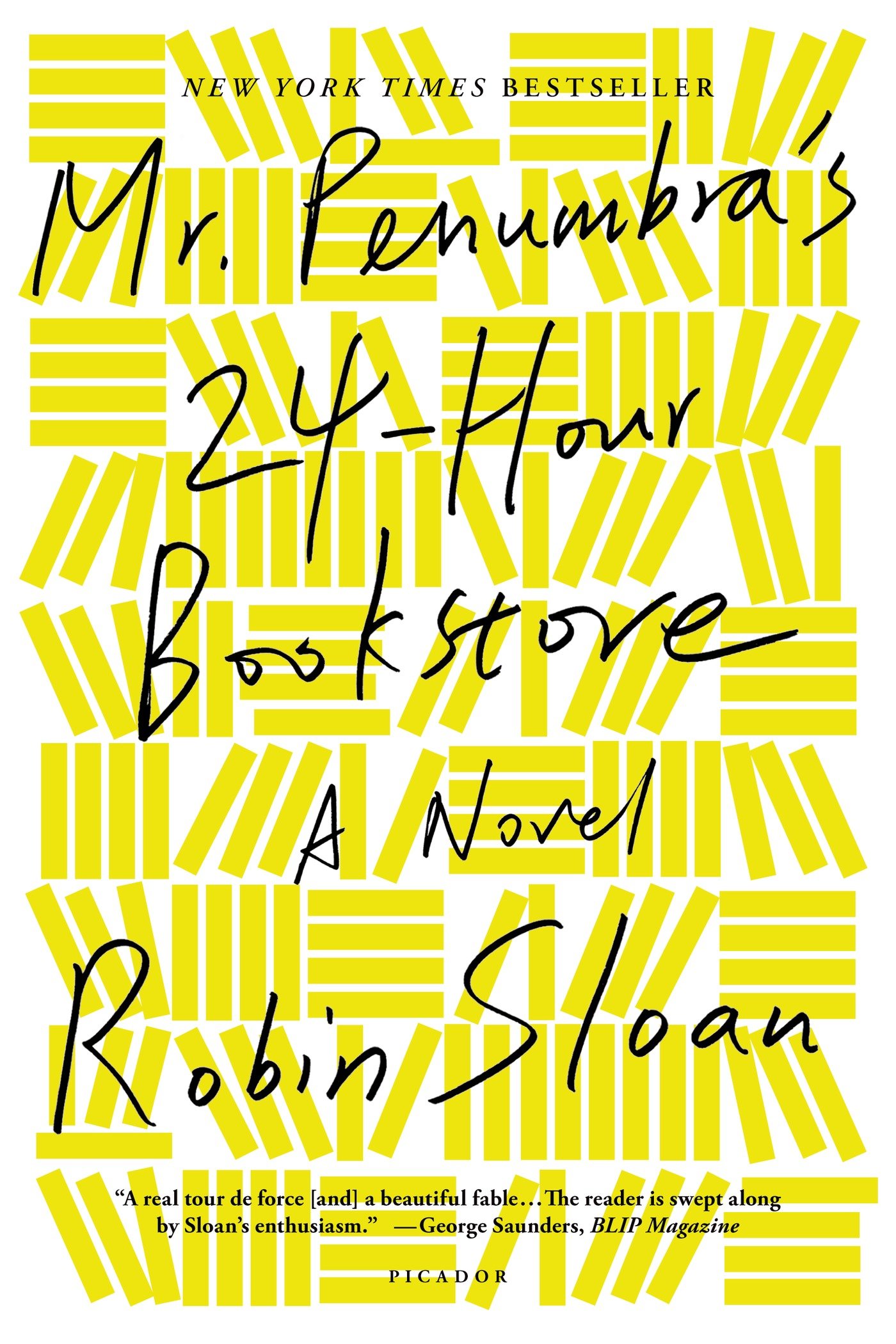
Review: Mr. Penumbra's 24-Hour Bookstore

Some books just sneak up on you, and for me, Mr. Penumbra's 24-Hour Bookstore, by Robin Sloan (FSG), was no exception. I had seen a lot of buzz on Goodreads about the book and managed to squeeze it in last month.

The book opens with Clay Jannon, a laid-off Web designer in San Francisco that gets a job as the overnight clerk at the eponymous bookstore.As he works there, he realizes the strange store has plenty of secrets. Along the way, he meets a gal who works at Google and are more in tune with modern technology than the bookstore or its patrons. While that premise may seem a bit short, the second half of the book is best kept unspoiled. Let's just say the book takes an unusual turn or two before it wraps up.

If I had to sum up the book in a word, it's quirky, and I don't mean that in a bad way. The Google designer character is a product of her time (apparently, the company will be able to solve all our problems), Clay's roommates are memorable in their brief moments, and Mr. Penumbra for some reason reminded me of a sort of literary Mr. Miyagi. A character towards the end that sort of acts as the story's villain reminded me of a few people I know in real life that detest modern technology. The usage of San Francisco as the setting works well and you can tell Sloan is familiar with the city and manages to weave in Industrial Light and Magic, Google's hometown of Mountain View, along with some landmarks and other Bay Area icons. There was a sense of authority during the sequences at Google, as though Sloan was using his own personal experience as a template. There are moments where the book seems to go off in a strange direction, but when the last page is read, it all ties together and makes a wonderfully cohesive plot.

In a summer that had few "light reading" books, Penumbra was a pleasant surprise. It still manages to pose big ideas about technology, the pending death of print publications, and how generations interact over technology while providing an entertaining story.

Rating: 4/5 stars

One bonus tidbit: If you buy the hardcover or paperback versions, expect the cover to glow in the dark. The first night I had it on my nightstand, I was trying to figure out what was glowing until I realized it was the book.