Showing posts with label nonfiction. Show all posts

Monday, December 1, 2014

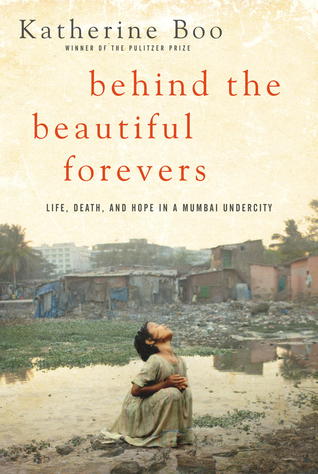
Book Review: Behind the Beautiful Forevers

When I told some friends that I was going to be reading Katherine Boo's book Behind the Beautiful Forevers (Random House), some asked in dismay why I'd read a book that screams "Downer!" I was somewhat taken aback by the question because I thought it inadvertently highlighted how there are some people that can walk this earth completely oblivious or ignorant to the plight of others around the globe. It's partly this reason why I try to read at least one book per year about some other country besides the U.S. This year, Forevers was one of two.

I've never been to India, but I understand the increasing role they play in the global economy. According to the World Bank, India's GDP was averaging 9.5% prior to the 2008 global recession, while the U.S. was averaging about 2.75%. When the recession hit, India's GDP had dropped to 4% and the U.S. rate was below zero. Factor in India's social caste system and its juxtaposing new fortune and the conditions create a horrible tease and grim reality for slum residents.

Perhaps that's nowhere more evident than in the slum of Annawadi, adjacent to the city's main airport, where Boo's tale of life in the Mumbai underclass takes place. The airport gleams with construction walls touting "Beautiful Forevers," hence the title, but behind those walls lie desperate people that want the benefits of their country's newfound economic muscle.

We meet several people along the way, including the ambitious Asha, the area's female slumlord; Abdul, a teenage boy who is the breadwinner for his family by picking garbage; Fatima, a one-legged woman who dies a terrible death; and Kalu, a homeless boy who is killed, but is hardly given a second thought by authorities.

Boo, a Pulitzer Prize winner, writer at The New Yorker and formerly of The Washington Post, writes of the residents' plight as a reporter and it shows. The level of detail in her writing is fantastic and balances a tender sense of care with the grim realities of life in Annawadi. Boo shatters any pre-conceived notions of a slumlord or of religious aid groups in the slum. The book won the National Book Award for nonfiction in 2012 and deservedly so.

It is an uncomfortable, heart-breaking and challenging read. There were many times where I had to set the book down and reflect on whether it was hypocritical to read about people so impoverished while I'm curled up on the couch enjoying a Coke on a warm fall day. It is impossible to read this book without feeling some empathy toward the people who were trying everything they could to get out of Annawadi and into India's middle class. It challenges ideas of income inequality, pure free-market capitalism and those it can leave behind.

Rating: 4/5 stars. Behind the Beautiful Forevers is a difficult and challenging read because of it's inherently brutal subject matter, but it is really well-written and illuminates a side of humanity few in America think about. I am better off for having read it.

While there hasn't been any talk of a film adaptation, though YouTube vlogger and author John Green has called for it, the National Theatre in London just opened a play based on the book. Below is an interview author Katherine Boo gave with the New York Public Library about the book.

Thursday, November 27, 2014

Book Review: Publishing

It's the watermark of writing: Getting a book published. Some writers hope to get their one dream book published, some manage to be the next James Patterson and get a million books published, and some go it alone and self-publish.

Gail Godwin's memoir on writing, Publishing, is set to be published January 13 by Bloomsbury, but I was able to review it early thanks to NetGalley. The book is a quick read and gives a taste of the author's quest to be published. Godwin opens the book with an author's nightmare: getting turned down by a scout from Knopf, one of the most distinguished publishing houses (many in the publishing world name Knopf and Farrar, Straus and Giroux as two of the most distinguished houses). Godwin manages to bounce back with several bestsellers including A Mother and Two Daughters (1982), Father Melancholy's Daughter (1991), and Evensong (1999).

All three were published by different houses, but Godwin explains some of the writing process, having an agent and editor among them. At one point, she laments changes at Viking after it became part of the Penguin Group. Considering the recent mega merger of Penguin and Random House, two titans in the publishing world, how does it compare now to the Viking-Penguin merger back then? That was a question I had during most of the book.

In the interest of full disclosure, I have not read any of Godwin's books prior to Publishing. Fans of hers will enjoy the behind-the-scenes look at how she wrote her books. I was more intrigued by the tales of her getting her books published, but there is also a fair amount of her life story intertwined as well.

Rating: 3/5 stars. I readily admit, I probably would have enjoyed this more had I read Godwin's previous works, but there was enough here to keep me invested. I was left wanting more details of the publishing industry, but Publishing was a good starting point.

Tuesday, November 18, 2014

Book Review: Dance Floor Democracy

Throughout my schooling and especially when I pursued a history minor in college, I thoroughly enjoyed studying World War II-era history. Some of my favorite films take place during that time period, ranging from 'Saving Private Ryan' to the pulpy 'The Rocketeer' and 'Indiana Jones' films.

I received Sherrie Tucker's Dance Floor Democracy: The Social Geography of Memory at the Hollywood Canteen as a NetGalley read, in part, because I was curious about an aspect of World War II-era history that I hadn't seen before. The Canteen was only open for three years, but nearly three million servicemen stopped by the club before or after being sent overseas. The club catered to all servicemembers, including women, and Allied soldiers. Starlets and actors would frequently dance with attendees and everything was free. Warner Bros. even made a film about the canteen towards the tail end of the war.

Sherrie Tucker's book is a very academic study in the history of the war via the nightclub, namely how the jitterbug dance represents the war to some younger generations and how people remember social history. However, I wasn't expecting it to be as academic of a study as it was (not that there's anything wrong with that, just not quite what I had prepared to read). Tucker delves into racism, sexism and other social forces, but is written in an academia-friendly way.

Rating: 2/5 stars. There's a good story to be had here, but it was way more technical than I was expecting, which made it a more difficult read. It veered off into directions that I wasn't expecting and admittedly, I lost interest at the halfway mark. Readers accustomed to university presses and more technical reading will enjoy it, so I can't give it my usual 1-star rating I give to books I don't finish. To the book's credit, it did make me look up more information on the Canteen.

Monday, November 10, 2014

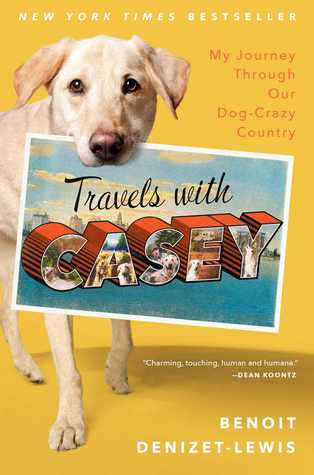
Book Review: Travels With Casey

Growing up, I had three retired racing greyhounds, Magoo, Zoey and Kismet. After watching a documentary on the horrors of greyhound racing, my parents contacted a local rescue agency and, over the years, we brought home the three. Being that greyhounds are one of the fastest land animals with speeds up to 46 mph, taking care of them required some additional protections. For example, taking a greyhound to an open park is an exceptionally bad idea, but taking them to the local elementary school's enclosed field isn't all that great either (school security guard nearly called the cops because we were trespassing).

Reading Benoit Denizet-Lewis' Travels With Casey (Simon & Schuster) reminded me of those years our family owned the greyhounds. Blending a travelogue and a pet-focused memoir, Denizet-Lewis takes his yellow labrador Casey all across America in a rented RV. The book looks at every aspect of pet ownership, from dog whisperer Cesar Milan's compound (which I didn't realize was in my hometown) to the Westminster Dog Show to the unpleasant reality of overcrowded animal shelters. There is one particularly gut-wrenching chapter about dogs' lives on Native American reservations in Arizona. That chapter led the author to do something most people wouldn't do, but is incredibly noble.

To call the book a travelogue is selling it a bit short. What makes the book work is that it's really about the people and less about the environments they are in, so if you're expecting a travel book akin to Bill Bryson's A Walk in the Woods, you'll be disappointed. Perhaps a better way to describe the book is that its a pet book that happens to involve travel rather than the other way around. A chapter that takes place in a Manhattan dog park had me laughing, but as Denizet-Lewis' journey progressed, the author has challenges in his own life as well as seeing the aforementioned darker side of dog life in America. For that, the author should be commended for showing an even-handedness in portraying dog life.

Unfortunately, the last third of the book felt rushed, as if the author's rented RV suddenly grew rocket boosters on its back and hauled buns across the country. Admittedly, the author was going through some relational issues at that point in the journey. However, the whole book was leading up to what Denizet-Lewis discovered from his travels around our dog-obsessed country and if his relationship with his dog was any better than before their trip, but the book ends before finishing developing these ideas.

Rating: 3.5/5 stars. Despite the rushed ending, there's a lot to like about the book and I would still recommend it. Travels With Casey has moments of humor, lots of heart and shares concern for those dogs not yet lucky to find a home. Any dog owner will enjoy it.

To see videos Benoit shot during the road trip, visit his YouTube page here.

Friday, November 7, 2014

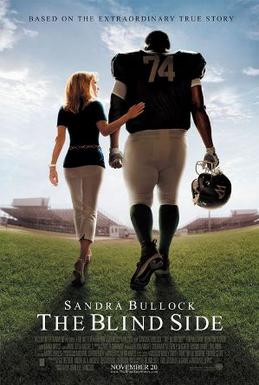
Film Friday: The Blind Side

Fall is a time to watch the boys of the gridiron and this month marks the 5-year anniversary of the theatrical release of The Blind Side. Based on the book by Michael Lewis, the film earned $255 million at the box office as well as a Best Picture Oscar nomination and netted Sandra Bullock an Academy Award for Best Actress. I remember finishing reading the book within a few days of seeing the movie opening night, hoping as all book fans do that the adaptation doesn't botch what was beloved about the original source material. Thankfully, director and screenwriter John Lee Hancock delivered.

In professional football, the game has become more dependent on the quarterback who captains the offense and often throws the ball. In order for the quarterback to get the proper amount of time to throw a pass or determine what he wants to do with the ball, he has to have a strong offensive line, particularly an all-world left tackle to protect his blind side from defensive pressure. Often, the left tackle is the second-highest paid player on the team besides the quarterback. Essentially, they're the QB's insurance policy.

Lewis' book delves into the history of the offensive lineman position and specifically, Michael Oher, a Memphis teen with a troubled childhood who gets taken in by the Tuohy family and discovers a talent for protecting the quarterback's blind side on the high school football team. The book's structure is set up to where the two key threads alternate, so one chapter is on the football specifics, then the next one is on Oher's story. At the time I read the book, I was more into the sports minutiae than the human interest side of the story, but there were moments where I wanted to blaze through the lineman history chapter and get to the next part of Michael's story. The book is well-paced and informative, but may not be the best for readers not interested in the football position details.

That's where the movie comes in, for better or for worse. The explanation of the offensive lineman position is limited to a brief opening sequence, but then focuses exclusively on Oher. Bullock was well-deserving of an Oscar for her role as Leigh Anne Tuohy, who spearheads the effort to take Michael in. The film is firmly rooted in realism (there's a lot of cameos by college coaches, namely current University of Alabama head coach Nick Saban) and the film's final scene is archive footage from the NFL Network of Oher being drafted by the Baltimore Ravens. When I saw the movie with friends who had not read the book, they were able to guess the plot threads correctly, so there are few twists and turns for the average audience. Overall, Bullock's performance elevates what would otherwise be a very ordinary movie. Rating for both the movie and book: 4/5 stars.

When the film was released, Oher was in his debut season with the Ravens. He went on to a 5-year career in Baltimore, winning the Super Bowl in 2012. He currently plays for the Tennessee Titans. Meanwhile, Oher's alma mater, the Ole Miss Rebels, has an outside shot of competing for the national championship as of this writing. They were at one point this season the No. 3-ranked team in the country. The team is coached by Oher's high school coach, Hugh Freeze. The Tuohys have gone on to be featured on television and countless interviews (Leigh Anne is an interior designer, husband Sean owns dozens of restaurant franchises and previously worked as a broadcaster for the Memphis Grizzlies NBA basketball team).

When Oher won the Super Bowl, ABC News did a follow-up piece on the story. If you can't see the video below, click here.

Since the film's release, director John Lee Hancock earned acclaim for directing Saving Mr. Banks, one of my favorite movies of 2013. Sandra Bullock was terrific last year in Gravity and Tim McGraw (Sean Tuohy) will be in next year's sci-fi film Tomorrowland, but actor Quinton Aaron (Michael Oher) and actress Lily Collins (Leigh Anne and Sean's daughter Collins Tuohy) have not had the same level of success post-Blind Side despite receiving acclaim for their roles.

Have you seen or read The Blind Side? What did you think?

Tuesday, November 4, 2014

Book Review: How Google Works

What was life like before Google again, I asked myself when I sat down to read Eric Schmidt and Jonathan Rosenberg's new book How Google Works (Grand Central). As I read through it, I realized just how many Google services I use. This blog runs on the company's Blogger, as does its feed manager, Feedburner. I search via Google, use the Chrome browser despite having Safari built into my Mac, use Gmail and once briefly flirted with the idea of having an Android smartphone, but thankfully, the iPhone became available on Verizon and that was that. The point is, so much of our lives has been impacted by the company that started out as a search engine with the colorful logo (does anybody even remember the early internet search days of Excite? AltaVista?)

There has been some debate and consternation online from early reviewers who were disappointed by the title, assuming it was about how Google compiles its search results or how the company came up with systems like Google Maps. I will emphasize that How Google Works is about how Google is managed and would be right at home in the business book section. Where the book excelled is explaining strategies of what makes Google successful. The sections on the company's "Don't be evil" mantra and the breakdown of the "smart creative" were particularly useful. As someone who works in a more creative industry, I read the sections that involved how to manage creatives with keen interest.

The book is a solid addition to the business book canon and does peel back the curtain slightly on the inner-workings of the Silicon Valley giant.

Rating: 3/5 stars. 

Disclaimer: I received a free copy of this book via NetGalley in exchange for a review.

Wednesday, October 22, 2014

Flatiron Books Launch

One of my first loves in reading is literary nonfiction. Rocket Boys, Band of Brothers, The Boys in the Boat, Friday Night Lights, just to name a few. So it is with a keen interest that I saw Macmillan, one of the big five publishers, launch a new imprint. Dubbed Flatiron Books after the famous Flatiron Building in New York, where Macmillan's headquarters happen to be based, the imprint is set to debut in the winter.

Macmillan explains the imprint as "committed to publishing intelligent fiction and nonfiction with commercial appeal by authors with distinctive voices." Based on that description, it seems like the imprint can be along the lines of Sarah Crichton's label at Farrar, Straus and Giroux or a much more selective Riverhead. Flatiron will be off to a good start with former New York Times and current Yahoo writer David Pogue debuting his book Pogue's Basics in December.

I purchased a Kindle Paperwhite recently and received a preview of the Flatiron sampler for Winter 2015 via NetGalley. Five nonfiction titles were previewed, but here were the three that stuck with me.

1) Irritable Hearts: A PTSD Love Story by Mac McClelland (Feb. 24)
Journalistic nonfiction is right in my wheelhouse and this book is no different. We as a society tend to think of PTSD as the result of being in a war, but McClelland suffers the disorder after a 2010 trip to Haiti to report on the devastation post-earthquake. She delves into the history of the disorder and how it impacts her as well those she meets. At times it reads like a suspense tale, but I was impressed by the level of detail and openness she expresses. It was a gripping, albeit difficult read at times given the subject matter, but of the five samples Flatiron provided this was the best of the bunch and the one that immediately made it onto my to-read list. 

2) A Kim Jong-Il Production: The Extraordinary True Story of a Kidnapped Filmmaker, His Star Actress, and a Young Dictator's Rise to Power by Paul Fischer (Feb. 3)
Part thriller and part world and cinema history, Paul Fischer's debut book chronicles the crazy but true story of North Korean dictator Kim Jong-Il's kidnapping of a South Korean director and actress in order to make better quality propaganda films. Fischer, a film producer who produced the documentary Radioman, Fischer explains Jong-Il as a petulant ruler who seeks worldwide acclaim for his films. Based on what we know of North Korea during his rule, his ambitions seem darkly comical but the means at which he aspired to achieve those ambitions were anything but. I have been going back-and-forth on adding this to my TBR, but would readily recommend it, especially to folks like a relative of mine who is both in film school and is interested in world history.

3) The Battle of Versailles: The Night American Fashion Stumbled into the Spotlight and Made History by Robin Givhan (March 17)
I'm not a fashion maven by any means. I don't like shopping for clothes and I don't get the hubbub over fashion shows. Having said that, I know the names of fashion icons like Oscar de la Renta, who passed away this week, Givenchy and Christian Dior. Part of that is the result of watching the Oscars for years and hearing the inevitable "Who are you wearing?" questions on the red carpet. Givhan's debut book, based on the preview, was well-researched and almost felt like the fashion equivalent of an underdog sports story. The book focuses on a 1973 fundraiser for Versailles when American fashion designers managed to tilt the focus of the fashion world from Europe to the U.S. Occasionally, I like to read things outside of my usual interest areas and based on the preview, I would consider this one. I'd also recommend this to a few friends of mine who are more in tune with the fashion world.

Monday, September 8, 2014

Review: The Boys in the Boat

Maybe it's from my youth and watching the likes of "The Mighty Ducks" and "Remember the Titans," but I've always loved an underdog story. Whether its people overcoming personal obstacles or rallying to become the champion when no one expected them to win, I love watching people triumph. In the case of Daniel James Brown's The Boys in the Boat: Nine Americans and Their Epic Quest for Gold at the 1936 Berlin Olympics, originally published last year by Viking but was just released on paperback this summer by Penguin, the reader gets the best of both worlds in an excellent, page-turning read.

The book tells the story of the 1936 University of Washington rowing, or crew, team as they beat the rival University of California team and went on to represent the U.S. in the Berlin Olympics. Brown profiles every member of the team, especially Joe Rantz, who survived a rough childhood to get to college. Every member of the crew faced the hardships of the Great Depression, growing up in Northwestern logging camps, dairy farms and mining towns. Brown paints each setting, whether its the shell house where the crew's boat is stored or the Olympic race course, with painstaking detail akin to Laura Hillenbrand's outstanding Unbroken and Seabiscuit.

Initially, there are some personality clashes as people vie for spots on the crew, not to mention the inner rivalries between the class levels. But as the team gels together, the pace of the book quickens and I found myself rooting for the team more and more. I would sit in bed reading into the late night hours audibly cheering for the crew. Even the side characters like coach Al Ulbrickson, boat designer George Pocock and the sports journalists that follow the team, especially Seattle sports icon Royal Brougham, are all fully fleshed out.

As the story shifts to Europe, the pace picks up and Brown explains beautifully how Hitler wanted the Games to be, particularly involving filmmaker Leni Riefenstahl, as well as how the team interacted with other Olympians. I have seldom watched an Olympic crew race on television, but I have a better understanding of the sport, both in terms of the strength and stamina needed and the strategy involved. I was absolutely riveted in the last race.

Here is the trailer for the book:

I absolutely loved this book and it is one of the top 3 books I've read this year. When I write feature stories, it's books like this that I aim for as an example of feature writing at its best. The book celebrates the triumph of what people can do when they work together as a singular unit and achieve great things. I try to be judicious in handing out 5-star ratings, but The Boys in the Boat is a book I'm glad I own in hardcover and will remain on my shelf for years to come. Rating 5/5 stars

Apparently, there is a film adaptation in the works. In 2011, more than two years prior to publication, The Weinstein Company purchased the film rights to the novel. The company distributed and produced such Oscar fare as "Silver Linings Playbook," "The Artist," and "The King's Speech." At the time, it was announced that"Thor" director Kenneth Branagh was attached to direct. However, there has been little to no new developments since the initial announcement.

Below, Brown further explains how he came to write the book at a Q&A session inside Washington D.C. literary landmark Politics and Prose: