Showing posts with label baseball. Show all posts

Monday, May 4, 2015

Audiobook Review: The Closer

The Closer: My Story (2014)
Written by Mariano Rivera with Wayne Coffey
Narrated by Michael Kay
Run Time: 7 hours and 25 minutes
Publisher: Hachette Audio/Little, Brown

In my years of being a baseball fan, I have always rooted against the Yankees (I'm a D-Backs and Red Sox fan, but of course, as I write this, the Sox are getting swept by the Yanks). Yankee players like Alex Rodriguez, Jason Giambi and Roger Clemens have earned my dislike over the years for a variety of reasons, but there were two Yankees that I had the utmost respect for: Derek Jeter and Mariano Rivera.

Rivera's autobiography The Closer is a terrific read, even for us born-and-raised Yankee haters. His humility is on every page, from his upbringing in Panama through his minor league career and into his days of walking out of the Yankee Stadium bullpen to Metallica's "Enter Sandman." A devout Christian, Rivera leaned on his faith throughout the highs (five world championships, 13 All-Star appearances) and the lows (injuries, key losses) of his career. I can't say I was all that bummed about hearing his losses since two of his big ones came against my teams, but hearing his descriptions of the games made me realize how personally he took them. He felt he let his entire team down and that sting didn't leave.

Role models in sports are hard to come by, especially in a sport that has been wracked with steroid scandals, egotistical players and contracts totaling north of $250 million. But Mo was never any of these things. I genuinely enjoyed hearing how he came up to the big leagues and had to adjust to living in America. His love for his wife Clara is evident every time he talks about her and how much of a pillar she was for him during his playing days. He mentions his faith often and it was a welcome perspective in my view, but it never felt overbearing.

I typically don't care for Michael Kay when he announces games (his victory chant of "Thaaaaaaaaaa Yankees win" is particularly annoying), so I proceeded with caution. He wasn't all that bad, but I got the sense that he was more comfortable recalling in-game moments. Considering the book is short in audiobook terms, clocking in at less than 8 hours, Kay reads Rivera's story at a quick and steady pace. I listened to it in one sitting as I was doing some house work.

Rating: 4/5 stars. Yankee fans will obviously enjoy this one, though there are universal themes of faith and perseverance in it that should make it accessible to everybody. Even us Red Sox fans.

The book is available in hardcover, ebook and audiobook formats. A paperback version from Back Bay Books is set to hit bookshelves May 5.

Friday, March 13, 2015

Film Friday: Shoeless Joe and Field of Dreams

Shoeless Joe (1982/1991)
Written by W.P. Kinsella
Narrated by Grover Gardner
Run Time: 7 hours and 46 minutes
Publisher: Blackstone Audio/Houghton Mifflin

Growing up, my dad shared his love of sports with my sister and I. The two sports he loved most were baseball and football. My sister played softball for years, often playing first base or pitcher while I operated the scoreboard or was the bat boy for some of her league games. I played T-ball at a young age, but I was terrible at it.

Years later, Dad and I would take occasional sabbaticals from California to Arizona, where I was born and where he grew up, to watch spring training baseball. By March, the desert heat would make the ballpark feel like it was summer, with some stadiums having open-air barbecues and sunbathers soaking up the UV rays on towels beyond the outfield fences. Hope is renewed for a successful season for each club, even for the legions of Cubs fans who make the annual pilgrimage to Mesa for spring training, despite their team not having won a World Series title in more than 100 years.

It is with this frame of reference that I recently read the classic book Shoeless Joe, or as its film version is known, Field of Dreams. The book, published in 1982 and made into an audiobook in 1991, is a wonderfully told story of an Iowa farmer named Ray Kinsella who hears the now-famous voice in his corn field "If you build it, he will come." As he builds a baseball field, Shoeless Joe Jackson, the famous Chicago White Sox outfielder indicted as part of the 1919 Black Sox scandal, appears. Eventually, Ray sets off on an adventure to meet author J.D. Salinger and little-known player Archibald "Moonlight" Graham. But as he is away, the farm is in danger of being snatched from Ray by his brother-in-law and business partner who don't see the value of the baseball diamond.

The book is solidly enjoyable as it focuses on the passing of bygone eras. It celebrates everything old-fashioned, from day games at ballparks to carnivals and older farming techniques. Some of these pay off while others didn't quite work for me. There's a whole subplot that involves Ray's brother and a traveling carnival that I didn't care about as much as I should have. The novel runs at such a quick pace, though, that it didn't detract from the main story. Amusingly, the book made me like J.D. Salinger, even though I really didn't like The Catcher in the Rye when I read it in high school. Gardner gives a great performance as the audiobook's narrator, providing just the right tone to fit each character, especially Salinger.

Grade: 4/5 stars. Despite an ending that felt a little too all-over-the-place, the book is a love letter to baseball and nostalgia.

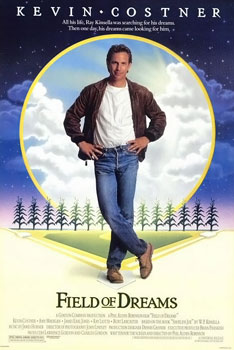
Field of Dreams (1989)
Written for the screen and directed by Phil Alden Robinson
Rated PG for some language and mild thematic elements
Run Time: 1 hour, 47 minutes
Distributor: Universal Pictures

In the interest of full disclosure, this is my favorite baseball movie, but I think that's in part because of how heavily it focused on the father-son relationship. In the book, the relationship between Ray and his father was a key part in the story, but the movie strips down the narrative to have the relationship be center stage. For example, there's a subplot unique to the movie about censoring questionable books that ties back into the relationship, since author Terrence Mann is blamed for the split. (Due to fears of litigation from Salinger, the character of Mann was created).

Two of my favorite scenes in the movie and book are almost verbatim from each other. The first is Ray's first meeting with Moonlight Graham in the ex-player's Minnesota office. Played by screen icon Burt Lancaster, Graham is resigned to hoping for another shot at the majors after realizing that "we just don't recognize the most significant moments of our lives while they're happening."


The second is the famous speech given by James Earl Jones' Mann about how "the one constant through all the years, Ray, has been baseball."


But what commentary on the movie would be complete without the scene that makes grown men cry? In the movie's final scene, the father-son relationship is healed, despite the father wearing a Yankees jersey. (In the book, he only played in the minor leagues and hated the Yanks).


Grade: 5/5 stars. While others may like Bull Durham or The Natural from the many 80's-era baseball movies, I'll gladly take Field of Dreams over them any day. The book's themes of faith in what you hold dear stand out and it's father-son subplot became the central plot in the movie.

Field of Dreams was nominated for three Academy Awards, including Best Picture, Best Adapted Screenplay and Best Original Score. Robinson went on to write and direct the 1992 hacker film Sneakers, as well as direct an episode of the lauded miniseries Band of Brothers and the action film The Sum of All Fears. James Horner conducted the music, one I play frequently, and went on to conduct the music for the likes of The Rocketeer, Apollo 13, Braveheart and Titanic, the latter of which won him an Oscar.

The field and farm where they shot the movie still stands and has been visited by more than a million visitors since the film's release. The field is near the town of Dyersville, Iowa and is routinely named as one of the top places to visit for baseball fans.

Friday, September 26, 2014

Film Friday: Moneyball

This weekend marks the final games of baseball's regular season, meaning the real season, the playoffs, will begin next week. Powerhouse teams like the New York Yankees and Boston Red Sox will be watching at home with the rest of us while teams that have languished for years without seeing a drop of championship glory are about to end their drought.

Sports teams have searched for years for some formula to repeated success. Some sports like football and hockey have a blueprint while others like baseball do not have any real formula outside of the cliched pitching and defense. Baseball is a sport that has so many arbitrary effects, it's nearly impossible to calculate. Pitchers can have a stellar season then return the next season and not have as good of command or miss the strike zone so much, their earned run average rockets upward (typically, the lower the average, the better the pitcher). Statistics like ERA and the search for a success formula in baseball is the basis for Michael Lewis' Moneyball (W.W. Norton), considered by many to be one of the best sports books ever written.

The book centers on Oakland Athletics general manager Billy Beane, who is consistently saddled with one of the lowest payrolls in baseball, yet manages to field competitive teams in most years. After losing slugger Jason Giambi to the Yankees during the 2001 offseason, Beane resorted to using sabermetric statistics and acquired players that had high on base percentages as opposed to the traditional home runs and runs batted in. As a result, the 2002 A's went on an unlikely run before losing in the playoffs that year.

In 2011, a film version of the book directed by Bennett Miller and starring Brad Pitt, Philip Seymour Hoffman and Jonah Hill made it to the big screen. Like the book, the movie was challenged in making a sports drama without much action and making statistics digestable. Frankly, the movie managed to do it better than the book. When reading the book, I felt it was mechanical at times, and I got lost in the statistics. There were memorable moments like when Billy addresses the scouting department that translated well to the film...


The screenplay, adapted by Steve Zaillian and Aaron Sorkin, a favorite script writer of mine, was very good in terms of getting the key points without being bogged down in the statistics. Pitt, as Beane, and Hoffman, as manager Art Howe, square off like their counterparts did in real life and make for some of the better scenes in the film. Many of the players were profiled in the book, but the only one that really stuck out to me was first baseman Scott Hatteberg, played in the film by Chris Pratt. The book doesn't talk as much about Beane's present personal life, while the film has a whole subplot involving his daughter (mentioned briefly in the book) that was a highlight of the movie. Both the book and film delve into his past as a failed major league prospect.

My favorite scene in both the book and the film was showing how trades in baseball can be made. Sports fans salivate over trade rumors and it was cool to read and see how one goes down. Here's a clip where Beane and Peter Brand, played by Hill, try to get the team's owner to add to the payroll to acquire Ricardo Rincon, a pitcher for the bullpen...


Overall, I'd rate the book a 3/5 stars while the film I rated 5/5 stars and was my pick for Best Picture during the 2011 Oscars. It was nominated for six Academy Awards including the aforementioned Best Picture, Best Actor (Pitt) and Best Adapted Screenplay. Unfortunately, it struck out and went 0/6 in wins. It isn't my favorite baseball movie, but it is certainly in the top 5.

Do you have a favorite baseball or sports movie that was adapted from a book?