Last week, Amazon announced its most recent quarterly earnings and they weren't so good. According to Publishers Weekly, there was a loss of $170 million mostly associated with the Fire smartphone and more students renting textbooks rather than purchasing them. Many readers on PW and other publications were quick to bash the internet giant. Some wondered if Kindles would eventually be shut down while others claimed the company's quarterly history indicates the end is nigh.
Some of the dislike toward Amazon is heightened by the company's ongoing battle with publishing giant Hachette. The group Authors United blasted Amazon for its hardball tactics, namely "refusing preorders, delaying shipping, reducing discounting, and using pop-up windows to cover authors' pages and redirect buyers to non-Hachette books." It should be noted that I am not a fan of these tactics either and have made adjustments, specifically buying Hachette titles from independent bookstores while the negotiations are ongoing.
However, people have used the event to paint Amazon with a broad brush and in the grand scheme of things, I'm in the middle. I realize being in the middle isn't the cool position in our hyper-partisan society (Democrat vs. Republican, Coke vs. Pepsi, DC vs. Marvel, Mac vs. PC, the list goes on), but hear me out.
After heavy research of e-readers like the Nook, Kobo and the Kindle, I recently purchased a Kindle Paperwhite in part so I can read new releases at a much more economical rate. Previously, I had only purchased paperbacks, which typically do not come out until a year after the book is initially released, because that was the most economical option. Nielsen announced earlier this month that paperbacks make up 42% of sales, but ebooks make up only 23% and hardcovers 25%.
For readers that only read a handful of books a year, I totally understand the anti-Amazon crowd and their support of local bookstores. According to IndieBound.org, if a person spends $100 at a local bookstore, $68 of that stays in the local area. If you shopped the same hundred bucks at a chain store, $43 stays in your town. Coincidentally, the difference, $25, is close to the average cost of a hardcover book. IndieBound also touts taxes being reinvested in the community. In the case of Los Angeles County, the sales tax alone is a whopping 9%.
I'm on pace to read 32 books this year. Let's assume for sake of the argument, that I bought all of those in hardcover at the average retail price. Based on figures from the School Library Journal, the average hardcover book cost is $27.20, which would total out to $870.40 in my scenario, not including sales tax. You might say, "Well, wait a minute, you said earlier you read paperbacks." Using the average price of a trade paperback, $17.84, the total cost would drop to $570.88. The School Library Journal did not compute ebook pricing, but they are even cheaper. I recently purchased Anthony Doerr's All the Light We Cannot See and Emily St. John Mandel's Station Eleven, both shortlisted for the National Book Award, for a combined total of $13 on my Kindle.
Also consider that while 32 books may seem like a lot (and frankly, to me it is), the average Goodreads reading challenge has 52 books in it. So of the 658, 079 participants that are in the 2014 reading challenge, an average number are planning to read a book a week during the calendar year. I'd hate to see the book expense bill on those accounts.
My love for independent bookstores is well-known. Vroman's Bookstore, one of the best in Southern California, is 45 minutes to an hour away from my house (assuming L.A. traffic wants to cooperate). Despite sporting a Kindle, I will still make the long drive down the hill to Vroman's and buy a paperback in support of the local bookstore occasionally.
All in all, I'd relax and ease off the doomsday predictions regarding Amazon. The company's self-publishing platform has enabled thousands of authors like nothing previously while publishing companies from Hachette to W.W. Norton to Penguin Random House have teams of copy editors, jacket designers, and others to create beautiful works of art in written form. Independent bookstores are thriving meeting places and often have the best author Q&A. The three can and will be able to coexist well into the future.
What do you think about the Amazon debate?
Showing posts with label Vroman's Bookstore. Show all posts
Showing posts with label Vroman's Bookstore. Show all posts
Wednesday, October 29, 2014

Wednesday, September 10, 2014
The Rise and Fall of Brick-and-Mortar Bookstores

The bookseller giant also said their stores benefited from the ongoing spat between Amazon and big publisher Hachette as well as book-to-film adaptations for the teen audience like Divergent, The Fault in Our Stars and If I Stay. As for a planned redesign of its website, retail CEO Mitch Klipper said it would be delayed until after the Christmas shopping season. I have to admit, BN.com isn't that bad. It doesn't beat Amazon, but then again, few e-commerce sites do.
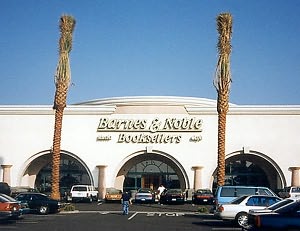 In my town of about 210,000, we've never had a genuine independent bookstore, but we used to have a Borders in addition to the Barnes and Noble. I used to peruse the two-story Borders right before catching a movie at the local megaplex (the two were adjacent to each other). Both the movie theater and Borders were adorned with figures like a cameraman outfitted with a cowboy hat and a little girl perched atop the Borders sign reading a book while the Barnes and Noble sat a couple of miles away across the street from the city's car dealerships. Since Borders went belly-up, the space it occupied has become a Gold's Gym and the figures are long gone (though the theater's is still there). Meanwhile, Barnes still draws a crowd, though it recently had its large wooden doors that it's had since opening replaced by dark, gun metal gray ones. Given the store's wood-and-green motif, the new doors are really out of place.
Ironically, as Barnes reported its earnings, Slate writer Zachary Karabell came out with a report on the growth of independent bookstores. During the late 1990's and early 2000's, big bookstore chains like Barnes & Noble and Borders were booming while independents were dying out. Karabell notes that 1,000 independent stores closed between 2000 and 2007. Now, shops like Washington's Politics and Prose and Portland's famously massive Powell's are booming with 8% growth over the past three years, according to Karabell. He makes an interesting point in that the big chains were looked at differently than Amazon and that's what did them in, but the independents have managed to dodge the whole mess altogether by offering author Q&A's on a bigger scale than ones offered by a chain store and cultivating a culture all their own. Independent stores are doing well in the hardcover nonfiction category, no surprise given the recent success of Unbroken, Hard Choices and In the Kingdom of Ice. Patrons flock to book signings, mingle over books and sellers offer suggestions on a wide variety of genres.

 Since I first went there last summer, I've quickly fallen in love with the place. A fair number of my paperbacks have been purchased from Vroman's. A few weeks back, they had an anniversary sale that allowed me to bring home some loot for $15. Walked out of there with three hardcovers, which is rare for me because I tend to favor paperbacks for the cost. I had been looking for A Man and His Ship for months and was about ready to give up and take the Amazon plunge before I found it at Vroman's, along with Fourth of July Creek and Travels with Casey, which were just released this summer. While independents still have some kinks to figure out, especially in the world of ebooks, here's to hoping they stick around for a long, long time.
Subscribe to:
Posts (Atom)