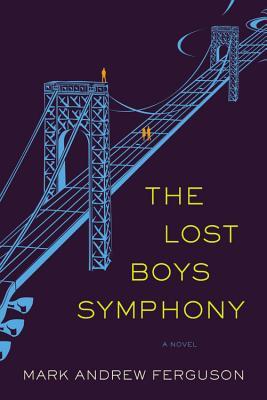
The Lost Boys Symphony (2015)
Written by Mark Andrew Ferguson
352 pages
Publisher: Little, Brown
Disclosure: I received a free advance digital review copy via NetGalley in exchange for a review. The book will be on store shelves March 24.
The scene is a classic. The man runs out to the middle of the bridge as snow is falling and screams "Help me Clarence! Get me back! I don't care what happens to me! Get me back to my wife and kids!"
The above scene from Frank Capra's Christmas classic It's a Wonderful Life has a distant cousin in Mark Andrew Ferguson's debut novel The Lost Boys Symphony. Henry is heartbroken after a breakup with his girlfriend Val when, while on the George Washington Bridge, two older versions of himself intervene and kidnap him. Naturally, his friend Gabe becomes increasingly concerned and contacts Val in efforts to find Henry.
I didn't care for the book as much as I thought I would, but that's not to say it was poorly written. Ferguson melds several genres together and at first, the plot strands don't quite gel. But as the novel progresses, the blend works really well. Ferguson uses sound descriptions throughout the book (after all, the title does refer to a symphony, the cover art features a guitar neck and headstock and Henry is a musician). After awhile, I began to wonder what this book would sound like if it were like a radio play with all the musical sounds and interludes.
However, I thought the novel was mostly dour and sometimes, downright bleak. Multiple characters look at the past, present and future with the proverbial glass half-empty outlook. This doesn't mean every character has to be happy-go-lucky, but the brief hints of humor were welcome relief from the overall dour tones, especially when characters lament not being able to adjust life events. Some of the drug and sexual humor was also not the right fit for me personally, though I know most wouldn't object to it.
Rating: 2/5 stars. This isn't a bad book per se and it's use of music to help tell the story is commendable, but it just wasn't a good match for me.
Book reviews, analysis of book-to-film adaptations, commentary on the latest from the world of publishing, and a few extras along the way.
Showing posts with label Hachette. Show all posts
Thursday, March 19, 2015
Tuesday, November 4, 2014
Book Review: How Google Works
What was life like before Google again, I asked myself when I sat down to read Eric Schmidt and Jonathan Rosenberg's new book How Google Works (Grand Central). As I read through it, I realized just how many Google services I use. This blog runs on the company's Blogger, as does its feed manager, Feedburner. I search via Google, use the Chrome browser despite having Safari built into my Mac, use Gmail and once briefly flirted with the idea of having an Android smartphone, but thankfully, the iPhone became available on Verizon and that was that. The point is, so much of our lives has been impacted by the company that started out as a search engine with the colorful logo (does anybody even remember the early internet search days of Excite? AltaVista?)
There has been some debate and consternation online from early reviewers who were disappointed by the title, assuming it was about how Google compiles its search results or how the company came up with systems like Google Maps. I will emphasize that How Google Works is about how Google is managed and would be right at home in the business book section. Where the book excelled is explaining strategies of what makes Google successful. The sections on the company's "Don't be evil" mantra and the breakdown of the "smart creative" were particularly useful. As someone who works in a more creative industry, I read the sections that involved how to manage creatives with keen interest.
The book is a solid addition to the business book canon and does peel back the curtain slightly on the inner-workings of the Silicon Valley giant.
Rating: 3/5 stars.
The book is a solid addition to the business book canon and does peel back the curtain slightly on the inner-workings of the Silicon Valley giant.
Rating: 3/5 stars.
Disclaimer: I received a free copy of this book via NetGalley in exchange for a review.
Wednesday, October 29, 2014
The Civil War Over Amazon
Last week, Amazon announced its most recent quarterly earnings and they weren't so good. According to Publishers Weekly, there was a loss of $170 million mostly associated with the Fire smartphone and more students renting textbooks rather than purchasing them. Many readers on PW and other publications were quick to bash the internet giant. Some wondered if Kindles would eventually be shut down while others claimed the company's quarterly history indicates the end is nigh.
Some of the dislike toward Amazon is heightened by the company's ongoing battle with publishing giant Hachette. The group Authors United blasted Amazon for its hardball tactics, namely "refusing preorders, delaying shipping, reducing discounting, and using pop-up windows to cover authors' pages and redirect buyers to non-Hachette books." It should be noted that I am not a fan of these tactics either and have made adjustments, specifically buying Hachette titles from independent bookstores while the negotiations are ongoing.
However, people have used the event to paint Amazon with a broad brush and in the grand scheme of things, I'm in the middle. I realize being in the middle isn't the cool position in our hyper-partisan society (Democrat vs. Republican, Coke vs. Pepsi, DC vs. Marvel, Mac vs. PC, the list goes on), but hear me out.
After heavy research of e-readers like the Nook, Kobo and the Kindle, I recently purchased a Kindle Paperwhite in part so I can read new releases at a much more economical rate. Previously, I had only purchased paperbacks, which typically do not come out until a year after the book is initially released, because that was the most economical option. Nielsen announced earlier this month that paperbacks make up 42% of sales, but ebooks make up only 23% and hardcovers 25%.
For readers that only read a handful of books a year, I totally understand the anti-Amazon crowd and their support of local bookstores. According to IndieBound.org, if a person spends $100 at a local bookstore, $68 of that stays in the local area. If you shopped the same hundred bucks at a chain store, $43 stays in your town. Coincidentally, the difference, $25, is close to the average cost of a hardcover book. IndieBound also touts taxes being reinvested in the community. In the case of Los Angeles County, the sales tax alone is a whopping 9%.
I'm on pace to read 32 books this year. Let's assume for sake of the argument, that I bought all of those in hardcover at the average retail price. Based on figures from the School Library Journal, the average hardcover book cost is $27.20, which would total out to $870.40 in my scenario, not including sales tax. You might say, "Well, wait a minute, you said earlier you read paperbacks." Using the average price of a trade paperback, $17.84, the total cost would drop to $570.88. The School Library Journal did not compute ebook pricing, but they are even cheaper. I recently purchased Anthony Doerr's All the Light We Cannot See and Emily St. John Mandel's Station Eleven, both shortlisted for the National Book Award, for a combined total of $13 on my Kindle.
Also consider that while 32 books may seem like a lot (and frankly, to me it is), the average Goodreads reading challenge has 52 books in it. So of the 658, 079 participants that are in the 2014 reading challenge, an average number are planning to read a book a week during the calendar year. I'd hate to see the book expense bill on those accounts.
My love for independent bookstores is well-known. Vroman's Bookstore, one of the best in Southern California, is 45 minutes to an hour away from my house (assuming L.A. traffic wants to cooperate). Despite sporting a Kindle, I will still make the long drive down the hill to Vroman's and buy a paperback in support of the local bookstore occasionally.
All in all, I'd relax and ease off the doomsday predictions regarding Amazon. The company's self-publishing platform has enabled thousands of authors like nothing previously while publishing companies from Hachette to W.W. Norton to Penguin Random House have teams of copy editors, jacket designers, and others to create beautiful works of art in written form. Independent bookstores are thriving meeting places and often have the best author Q&A. The three can and will be able to coexist well into the future.
What do you think about the Amazon debate?
Some of the dislike toward Amazon is heightened by the company's ongoing battle with publishing giant Hachette. The group Authors United blasted Amazon for its hardball tactics, namely "refusing preorders, delaying shipping, reducing discounting, and using pop-up windows to cover authors' pages and redirect buyers to non-Hachette books." It should be noted that I am not a fan of these tactics either and have made adjustments, specifically buying Hachette titles from independent bookstores while the negotiations are ongoing.
However, people have used the event to paint Amazon with a broad brush and in the grand scheme of things, I'm in the middle. I realize being in the middle isn't the cool position in our hyper-partisan society (Democrat vs. Republican, Coke vs. Pepsi, DC vs. Marvel, Mac vs. PC, the list goes on), but hear me out.
After heavy research of e-readers like the Nook, Kobo and the Kindle, I recently purchased a Kindle Paperwhite in part so I can read new releases at a much more economical rate. Previously, I had only purchased paperbacks, which typically do not come out until a year after the book is initially released, because that was the most economical option. Nielsen announced earlier this month that paperbacks make up 42% of sales, but ebooks make up only 23% and hardcovers 25%.
For readers that only read a handful of books a year, I totally understand the anti-Amazon crowd and their support of local bookstores. According to IndieBound.org, if a person spends $100 at a local bookstore, $68 of that stays in the local area. If you shopped the same hundred bucks at a chain store, $43 stays in your town. Coincidentally, the difference, $25, is close to the average cost of a hardcover book. IndieBound also touts taxes being reinvested in the community. In the case of Los Angeles County, the sales tax alone is a whopping 9%.
I'm on pace to read 32 books this year. Let's assume for sake of the argument, that I bought all of those in hardcover at the average retail price. Based on figures from the School Library Journal, the average hardcover book cost is $27.20, which would total out to $870.40 in my scenario, not including sales tax. You might say, "Well, wait a minute, you said earlier you read paperbacks." Using the average price of a trade paperback, $17.84, the total cost would drop to $570.88. The School Library Journal did not compute ebook pricing, but they are even cheaper. I recently purchased Anthony Doerr's All the Light We Cannot See and Emily St. John Mandel's Station Eleven, both shortlisted for the National Book Award, for a combined total of $13 on my Kindle.
Also consider that while 32 books may seem like a lot (and frankly, to me it is), the average Goodreads reading challenge has 52 books in it. So of the 658, 079 participants that are in the 2014 reading challenge, an average number are planning to read a book a week during the calendar year. I'd hate to see the book expense bill on those accounts.
My love for independent bookstores is well-known. Vroman's Bookstore, one of the best in Southern California, is 45 minutes to an hour away from my house (assuming L.A. traffic wants to cooperate). Despite sporting a Kindle, I will still make the long drive down the hill to Vroman's and buy a paperback in support of the local bookstore occasionally.
All in all, I'd relax and ease off the doomsday predictions regarding Amazon. The company's self-publishing platform has enabled thousands of authors like nothing previously while publishing companies from Hachette to W.W. Norton to Penguin Random House have teams of copy editors, jacket designers, and others to create beautiful works of art in written form. Independent bookstores are thriving meeting places and often have the best author Q&A. The three can and will be able to coexist well into the future.
What do you think about the Amazon debate?
Subscribe to:
Posts (Atom)