Showing posts with label Ecco. Show all posts

Wednesday, April 22, 2015

Audiobook Review: Water to the Angels

Water to the Angels: William Mulholland, His Monumental Aqueduct and the Rise of Los Angeles (2015)
Written by Les Standiford
Narrated by Robert Fass
Publisher: HarperAudio/Ecco
Run Time: 9 hours 11 minutes

Seldom does one get to read books that directly involve their town, but in the case of Les Standiford's Water to the Angels, my hometown of Santa Clarita plays a strong supporting role. Some cities have canals, rivers or lakes as water sources. Our primary source is a lake, but the Los Angeles Aqueduct traverses our hills and valleys as it snakes its way to the big city to our south.

The high school I went to sits next to the aqueduct, or as students called it, "The Pipe." When I was on the JV and freshman volleyball teams, we used to run on a dirt trail next to it. The aqueduct looms over one of Santa Clarita's biggest parks, where families walk their pets and play baseball, soccer and ultimate frisbee on the weekends. At times, it sits at ground level and in other places, is mounted onto concrete stilts as it climbs and descends hills.

Standiford's book begins with one of my town's most notorious disasters, the St. Francis Dam disaster of 1928. The dam acted as a reservoir for the aqueduct. When it broke, thousands of gallons of water rushed through the Santa Clarita Valley, into the Santa Clara River (which is normally dry) and barreled through the farmlands of Fillmore and Santa Paula before it flowed into the Pacific Ocean at Ventura. The site of the dam is about a 20 minute drive from my house and if you know what to look for, remnants are still visible from the canyon road that passes by the area. Standiford does provide some details and historical perspective about the incident, particularly from the dam supervisor who seemed concerned about the St. Francis when few others were.

Standiford's book primarily focuses on the engineering of the aqueduct and while the planning and building of it is certainly worth writing about, I didn't expect the bulk of the book to be devoted to it. William Mulholland, who would later have the famous curvy mountain highway named after him, is a central figure in the book and rightly so. The Los Angeles Department of Water and Power, of which Mulholland was the longtime head of in the city's early days, has been highly influential in Los Angeles' development for years and it traces back to the aqueduct and its designer. The portions of the book with Mulholland in them were the strongest parts.

Another strong focus is the battle between Owens Valley residents and Los Angeles. The aqueduct designers put the intake channel so far up the Owens River, it devastated farmers below. As a result, the aqueduct is still a point of contention today.

Since "The Rise of Los Angeles" is part of the subtitle, I was hoping there would be a history as to how the aqueduct helped spur the population boom the city had in the mid-20th century. The San Fernando Valley, home to the reservoir that serves as the endpoint of the aqueduct, went from being farmland to vast cityscape. Communities as far away as Huntington Beach and Pasadena started to flourish in the 1920s and drew residents via the Red Car Trolleys. Were those developments helped by the aqueduct? Also, when we say Los Angeles, do we mean the city or the metro area, the latter of which gives new meaning to the word sprawl?

As a bonus, the end of the book focuses on the 1974 film Chinatown, which is partially based on the early days of the LADWP and the water rights war between Los Angeles and the Owens Valley.

Rating: 3/5 stars. It's a good starting point of early Los Angeles history and its thirst for a sustaining water source. However, I still had questions as to how the aqueduct helped trigger LA's boom and the emphasis on the construction was a surprise, given the human drama of the water wars and the dam disaster. It should also be noted that based on some other reviews, some readers looked to the book for any commentary on our state's current drought situation, but this isn't the book for that.

Tuesday, January 27, 2015

Nonfiction Audiobook Medley

As the month of January is drawing to a close, I've been racing through nearly a half-dozen audiobooks. Here are three pleasant nonfiction selections that I've finished that span the memoir, travel and history genres.


As You Wish: Inconceivable Tales from the Making of The Princess Bride (2014)
Written by Cary Elwes and Joe Layden
Narrated by Elwes and most of the film's cast
Run Time: 7 hours
Publisher: Simon & Schuster Audio/Touchstone

For many summers growing up, I would often go to Christian camps in the mountains north of Los Angeles. Like clockwork, they would show a movie on select nights. The film would always be, without fail, The Princess Bride. It got to the point where I was burned out on the movie, but luckily, as time has passed, my liking toward the movie has returned. It is indeed a classic, as Cary Elwes points out in his book on multiple occasions.

What made the audiobook so enjoyable isn't necessarily what was written, but rather that Elwes managed to get most of the cast back together. So when the parts involving Billy Crystal's Miracle Max character pop up, it's Crystal talking about it from his perspective. Ditto with Robin Wright's Buttercup and Wallace Shawn and director Rob Reiner. In that sense, it almost takes on the persona of a radio play. Elwes' writing has a few of my pet peeves in it, such as teasing the reader with "more on that later," but again, the audio experience and the genuine affection the cast conveys toward the film and each other make up for any flaws. Have fun storming the castle with this one. Grade: 4/5 stars (Also available in ebook and hardcover formats).

The Promise of a Pencil: How an Ordinary Person Can Create Extraordinary Change (2014)
Written by Adam Braun
Narrated by Kirby Heybourne
Run Time: 7 hours, 32 minutes
Publisher: Simon & Schuster Audio/Scribner

We often hear about the plight of people in developing regions of the world, but seldom do people actually do something about it. Braun, to his credit, did something and launched Pencils of Promise, a charity dedicated to building schools in impoverished regions of the world. He takes readers from New York to Laos to Central America to Ghana and back again as he grows his charity. A hybrid of memoir, travel and business writing, the book tries to cater to multiple audiences.

I had a couple of issues with the book. First, the subtitle usage of 'Ordinary Person' is a huge stretch considering Braun previously worked at Bain and Company as a business consultant before starting PoP and was Ivy League-educated at Brown. He may have started very small, but he used the business management skills he learned from Bain to rapidly grow his charity to where it is now. Second, the book has multiple sections that can come across to some readers as self-congratulatory. Overall, I liked the book, but can't give it the full-throated, enthusiastic approval I hope to give every book I pick up. Grade: 3/5 (Also available in ebook and hardcover formats; paperback edition debuts next week.)

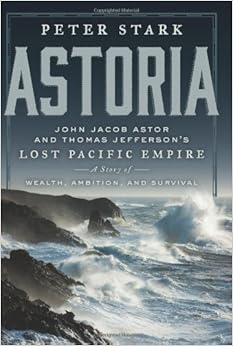
Astoria: John Jacob Astor and Thomas Jefferson's Lost Pacific Empire: A Story of Wealth, Ambition and Survival (2014)
Written by Peter Stark
Narrated by Michael Kramer
Run Time: 10 hours, 55 minutes
Publisher: Harper Audio/Ecco

When the originators of the expression "Whatever can go wrong, will go wrong" coined that phrase, you'd think the tale of Astoria was in their minds. The story of the journey to establish a colony at the mouth of the Columbia River in the Pacific Northwest in the early 1800s, Astoria has the makings of a tour-de-force read. Bickering settlers, nationalistic rivalries, deadly winters and a wealthy backer bent on seizing the world's fur trade should make for a compelling story, considering it was known by most Americans in the mid-1800s via writer Washington Irving.

However, for every harrowing description of the overland and sea journeys and character studies of the various men and women involved, the writing pounds into your skull repeated phrases like "John Jacob Astor's West Coast empire" that dulls the rest of the story. As a result, the book gets monotonous fast. It should also be noted that contrary to the subtitle, Jefferson's involvement was more of a blessing of the enterprise rather than any hands-on action. It's not a bad book, but it makes you wonder what could have been were it not for the incessantly repeated phrases that make it seem as though the author didn't trust his audience to be able to follow along. Grade: 3/5 stars (Also available in ebook and hardcover formats; paperback edition debuts Feb. 10.)